
Siding vs Trim Damage: How to Tell the Difference
Learn to identify whether damage is siding or trim, why it matters for repairs and costs, and when to call a professional for Seattle homes.
By Seattle Trim Repair · Published · Updated
When you notice exterior wood damage on your Seattle home, the first question is often not “what caused this” but “what exactly is damaged.” Is the problem in the siding or the trim? For many homeowners, the distinction is unclear because both are exterior wood components that look similar when painted the same color. However, siding and trim are different systems with different functions, different failure modes, and different repair requirements.
Understanding whether damage affects siding or trim determines repair urgency, scope, and cost. Trim damage is often more critical because trim protects the transitions and joints where water intrusion into wall cavities is most likely. Siding damage, while important, usually remains surface-level longer before it compromises structural components. Misidentifying the problem leads to incomplete repairs that fail quickly, wasting time and money.
What is Siding?
Siding is the large-area cladding that covers exterior walls. It is the primary weather barrier, shedding rain and blocking wind. Common siding types in Seattle include horizontal lap siding (beveled cedar, fiber cement, or engineered wood), vertical board-and-batten, wood shingles, and panel systems.
Siding covers broad, flat wall surfaces between windows, doors, and corners. It is designed to overlap and create a shingled effect that directs water downward and outward. When siding is installed correctly over a drainage plane and weather barrier, it keeps the wall cavity dry even during prolonged rain.
Siding takes weather exposure across its entire surface area. UV damage, impact from debris, and moisture cycling affect siding uniformly over large areas. Failures tend to be visible from a distance: warping panels, faded or cracked finish, missing pieces, or sections pulling away from the wall.
What is Trim?
Trim is the detail carpentry that covers edges, joints, and transitions. It includes window and door casings, corner boards (inside and outside corners), fascia boards along roof edges, soffit panels under eaves, rake boards on gable ends, and water table trim at the foundation line. Trim is also called exterior millwork or finish carpentry.
Trim serves two purposes: it provides a finished appearance by covering the gaps where different materials meet, and it directs water away from vulnerable joints. A well-detailed window casing, for example, sheds water away from the gap between the window frame and the wall, preventing moisture from running into the wall cavity.
Trim is more vulnerable to moisture damage than siding because it sits at collection points. Horizontal trim surfaces like window sills become shelves where rain sits. Vertical joints where trim meets siding create channels where water flows and pools. In Seattle’s climate, where these surfaces may stay wet for days without drying, trim is where rot most often begins.
How to Identify Siding Damage
Siding damage presents differently than trim damage. Learn to recognize these patterns to accurately diagnose problems.
Warping and Buckling
Siding panels that appear wavy, bowed, or pulled away from the wall indicate moisture damage behind the panels. Water that gets behind siding causes the sheathing or the siding itself to swell and distort. In Seattle, this is common on south and west walls where afternoon sun heats rain-soaked panels, accelerating warping.
Buckling also occurs when siding is fastened too tightly and cannot expand and contract with moisture and temperature changes. The panels push against each other and deform.
Cracking and Splitting
Horizontal cracks running along the length of a siding board usually result from age, impact, or drying shrinkage. Vertical splits indicate the material has dried out and contracted beyond its dimensional stability. Fiber cement siding can develop hairline cracks where it was face-nailed too tightly, restricting movement.
Fading and Discoloration Over Large Areas
When large sections of wall show uneven color or faded finish, the paint or stain is breaking down from UV exposure and weathering. This is initially cosmetic but becomes a moisture problem as bare material absorbs water. Cedar siding left unfinished weathers to gray; painted siding with failed finish shows wood grain and may have dark streaks from tannin bleed.
Soft or Spongy Panels
Press on siding mid-panel, away from seams and trim. If it gives under thumb pressure, moisture has penetrated and rot is developing. On cedar siding, this often means dry rot fungus has taken hold beneath the paint. On fiber cement or engineered wood, it indicates water saturation and delamination.
Gaps Between Siding Courses
As siding ages and the structure settles, gaps can open between courses. In a climate that receives 37 inches of annual rain, these gaps are invitations for water intrusion. Check that lap siding maintains consistent 1-1.25 inch overlaps with no visible gaps.
How to Identify Trim Damage
Trim damage is often localized and concentrated at specific failure points. It requires closer inspection than siding damage because it can be hidden by paint or occur in tight spaces.
Soft Wood at Joints and Corners
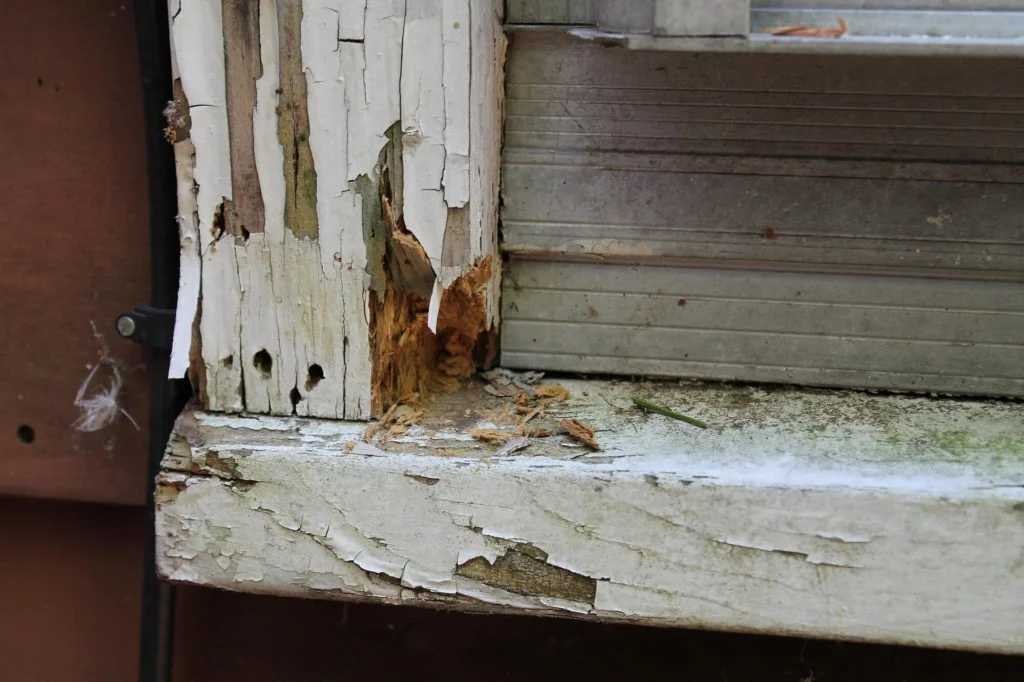
The most common trim damage occurs where two trim pieces meet: the bottom corner of a window casing where the sill meets the vertical casing, the junction of a corner board and fascia, or where a door casing meets the threshold. These joints trap moisture and rot spreads outward from them.
Press on these joints with your thumb. If the wood is soft, probe with a screwdriver. Trim rot often penetrates deeper than surface appearance suggests.
Localized Paint Failure
Unlike siding damage that shows fading across large areas, trim damage presents as bubbling, peeling, or flaking paint in concentrated spots. If paint is failing on window frames but surrounding siding looks fine, the trim is failing due to moisture coming from behind.
Gaps Between Trim and Siding
When trim shrinks, swells, or rots, it pulls away from the siding it borders. You will see daylight or shadow lines at these seams. This is common around window casings, door frames, and corner boards. Gaps indicate that the trim is no longer performing its function of sealing the joint.
Dark Staining at Edges
Water stains that follow the outline of a trim board, particularly along the bottom edge of fascia or beneath window sills, show that water is sitting on or running behind the trim and not draining properly. These stains often precede visible rot by months.
Insect Activity Near Trim
Carpenter ants and other wood-destroying insects prefer wood that is already softened by moisture. If you see small piles of sawdust-like debris near exterior trim, the wood is compromised. Insects are often the first visible sign of hidden rot.
Why the Distinction Matters
Knowing whether damage is siding or trim is not academic. It directly affects how the repair is done, what it costs, and how quickly you need to act.
Different Repair Approaches
Siding repair involves removing damaged boards or panels and weaving new material into the existing courses. The challenge is matching profile, thickness, and finish so the patch blends in. Removing siding often requires disturbing multiple courses to access the damaged section, particularly with lap siding that interlocks.
Trim repair is finish carpentry. Each piece is custom-fit to its location, with precise cuts and tight joints. Trim sits at the most visible parts of the home—around windows, doors, and corners—so the quality of the work is immediately apparent. Trim repair also requires addressing the root cause of failure, which usually involves flashing installation or correction.
Different Cost Structures
Siding repairs use more material because they cover larger areas, but the work is often more straightforward. Trim repairs use less material but require more labor per linear foot due to detail work, custom fitting, and the need to install proper flashing at each joint.
A homeowner who assumes all exterior wood damage is a siding problem may be surprised to learn the issue is actually a few trim boards, which could be a smaller and more affordable fix. Conversely, someone focused only on visible trim damage may miss underlying siding failure that needs attention.
Different Urgency
Trim damage is often more urgent than siding damage. Trim protects the transitions where water is most likely to enter wall cavities. A rotted corner board or failed window casing is essentially an open door for moisture to reach sheathing, insulation, and framing.
Siding damage, while important, usually stays on the surface longer before it compromises the structure behind it. A warped siding panel mid-wall may be cosmetic for months before moisture penetrates to the sheathing. However, once siding damage allows bulk water intrusion, it can cause extensive hidden damage quickly.
How Seattle’s Climate Affects Siding and Trim Differently
Seattle’s rain pattern—long stretches of steady drizzle with limited drying periods—affects siding and trim in distinct ways.
Siding takes rain across its entire broad surface. Well-maintained siding sheds most water effectively because it is designed as a flat, overlapping barrier. Problems develop when paint fails, caulk cracks, or panels shift, allowing water to wick behind the surface through capillary action.
Trim faces a harder challenge. Water flows downhill and collects at transitions. Every horizontal trim surface—the top of a window casing, the flat face of fascia, the ledge of a water table board—becomes a shelf where rain sits. Every vertical joint between trim and siding becomes a channel where water runs and pools.
In Seattle, where moisture may not fully evaporate for weeks during fall and winter, these collection points are where rot begins. This is why many Seattle homes have perfectly intact siding but badly deteriorated trim around windows and along the roofline. The siding did its job shedding water, but the trim took the brunt of moisture accumulation at every seam and edge.
When Siding and Trim Damage Are Connected
In many cases, siding and trim damage are not isolated. Moisture travels, and damage in one area often spreads to the other.
Trim Rot Spreading to Siding
A rotted window sill or corner board allows water to penetrate behind adjacent siding panels. You might notice the trim damage first, but by the time you address it, the siding boards closest to the trim may also need replacement. This is extremely common with window casings in Seattle homes built before 1990, where decades of rain have slowly worked moisture from trim joints into the surrounding wall.
Siding Failure Exposing Trim
When siding panels crack, warp, or pull away from the wall, they expose edges of trim boards that were previously protected by the siding overlap. Those newly exposed trim edges were never finished or sealed because they were not meant to face weather directly. Once exposed, they absorb moisture rapidly and rot can set in within a single wet season.
Shared Flashing Failures
Often, the same piece of flashing protects both trim and adjacent siding. If that flashing fails due to age, improper installation, or corrosion, both the trim and siding in that area become vulnerable. This is particularly common above windows and doors and at the junction between a roof and a wall.
What to Do When You Are Not Sure
If you are uncertain whether damage is siding, trim, or both, take a systematic approach.
Walk your home’s perimeter and look at each wall from about 10 feet back. Note any areas where color, texture, or alignment looks off. Get closer where you safely can and press on suspicious areas with your thumb. Soft wood means rot, regardless of whether it is siding or trim.
Identify what you are touching. Is it a large panel covering the wall (siding)? Or is it a border piece around a window, door, corner, or roofline (trim)? Check the joints where trim meets siding, where trim meets trim, and where siding meets penetrations like vents or faucets. These are the highest-risk areas.
Take photos—close-ups and wider context shots. If the damage is obvious and limited to one or two boards, you may be able to identify it yourself. But if the area is large, high up, or near a critical entry point like a window or roofline, a professional inspection is the smart move.
Catching damage early and correctly identifying what needs repair almost always saves money over waiting and guessing. For Seattle-area homeowners who need help diagnosing exterior damage, contact our team at (425) 517-1751 for a free inspection. We will identify exactly what is damaged, what caused it, and what it will take to fix it correctly.
Not sure how bad yours is?
Send a photo or describe the spot over the phone. We will tell you whether it is a patch, a section, or something structural before anyone comes out.
Mon–Fri, 7:00am – 5:00pm
Questions homeowners ask us about this
What is the difference between siding and trim?
Why does it matter whether damage is siding or trim?
How can I tell if damage is siding or trim?
Can siding and trim damage occur together?
Read next
- Trim Repair
5 Signs Your Exterior Trim Needs Replacement
Learn the key warning signs that your home's exterior trim needs replacement to prevent costly structural damage and maintain curb appeal.
- Siding Repair
Siding Repair vs. Replacement: How to Decide
Should you repair or replace your siding? Decision framework with Seattle cost ranges, the 30 percent rule, and material-specific guidance.
- Dry Rot
5 Warning Signs of Structural Damage on Home Exteriors
Identify critical structural damage signs: foundation cracks, dry rot, warped siding, gaps around openings, and bowing walls. Know when to call professionals.
Where this leads
Get a straight answer on your siding, trim, or rot
Free estimate, no obligation, and usually a slot the same week. We cover Seattle, Bellevue, Redmond, Kirkland, Bothell, and Tacoma.
Mon–Fri, 7:00am – 5:00pm · Free estimates · Same-week scheduling